

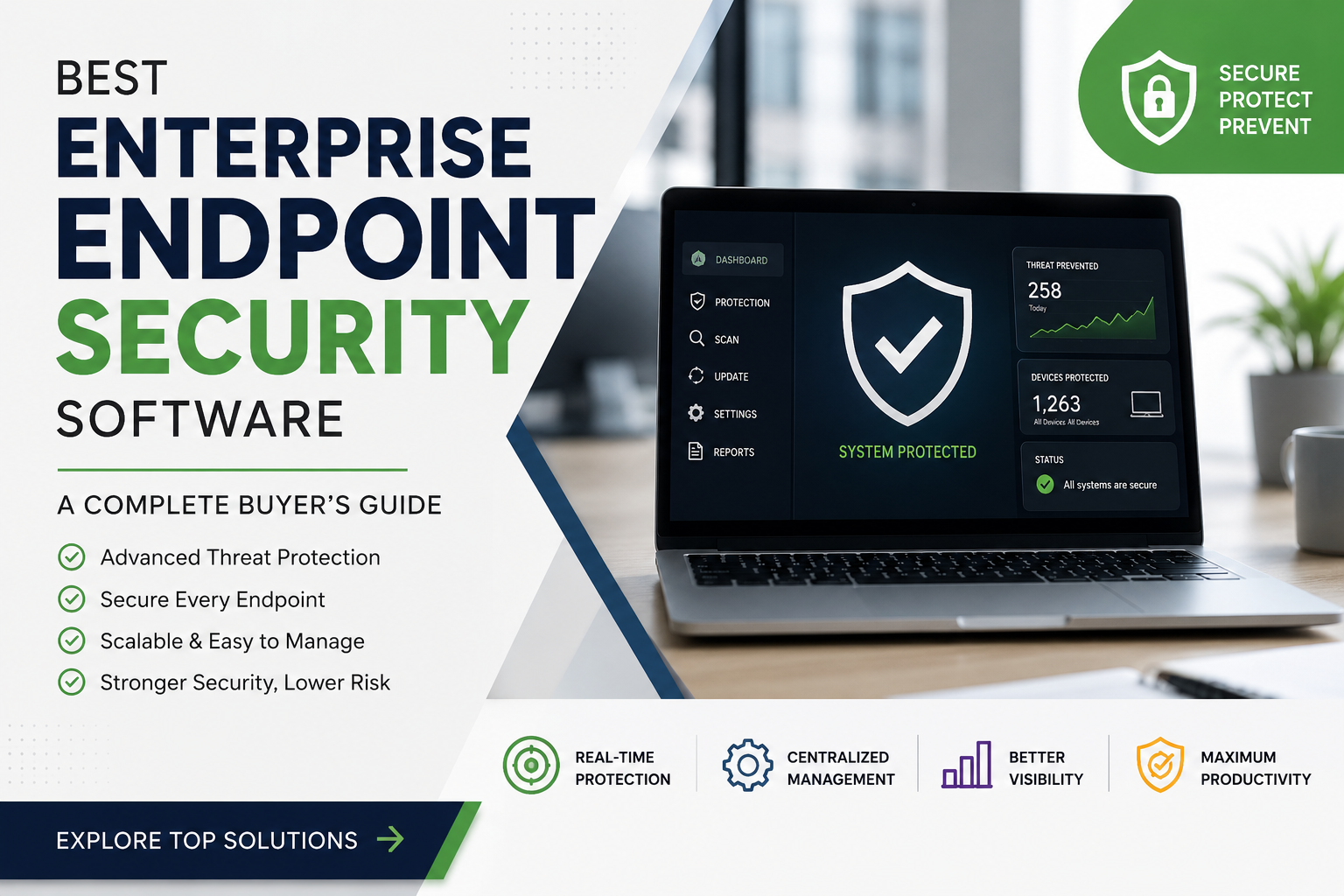
Every laptop, desktop, mobile device, and server connected to a corporate network represents a potential entry point for attackers. As organizations expand their remote and hybrid workforces, the number of these entry points — known as endpoints — has grown dramatically, and so has the sophistication of threats designed to exploit them. Endpoint security software has evolved from simple antivirus scanning into comprehensive platforms capable of detecting, blocking, and responding to advanced threats in real time. This guide walks through what enterprise endpoint security actually means today, what capabilities matter most, and how organizations can evaluate their options.
What Is Enterprise Endpoint Security?
Enterprise endpoint security refers to a category of software designed to protect every device that connects to a company’s network — including laptops, desktops, smartphones, tablets, servers, and increasingly, IoT devices. Unlike traditional antivirus tools that rely primarily on signature-based detection, modern endpoint security platforms combine multiple layers of defense, including behavioral analysis, machine learning, threat intelligence feeds, and automated response capabilities.
The shift toward endpoint-centric security reflects a broader change in how organizations think about their attack surface. With cloud adoption, remote work, and bring-your-own-device (BYOD) policies becoming the norm, the traditional network perimeter has effectively dissolved. Every endpoint is now a potential perimeter of its own, which is why endpoint protection has become one of the highest investment priorities for IT and security teams.
Core Components of a Modern Endpoint Security Platform
Next-Generation Antivirus (NGAV)
Traditional antivirus software relies on known malware signatures, which means it can only catch threats that have already been identified and cataloged. Next-generation antivirus takes a different approach, using machine learning models trained on massive datasets of malicious and benign files to identify threats based on behavior and characteristics, even if the specific malware variant has never been seen before. This is particularly important for catching polymorphic malware that changes its code to evade signature detection.
Endpoint Detection and Response (EDR)
EDR tools continuously monitor endpoint activity, recording events such as process execution, file modifications, registry changes, and network connections. This data is analyzed for signs of malicious behavior, and when a threat is detected, security teams can investigate the full timeline of the attack, understand its scope, and take remediation action — whether that means isolating a device, killing a malicious process, or rolling back changes.
Extended Detection and Response (XDR)
XDR expands on EDR by correlating data not just from endpoints, but from network traffic, cloud workloads, email systems, and identity platforms. This broader visibility helps security teams spot attacks that span multiple systems, which is increasingly common as attackers move laterally through networks after an initial compromise.
Threat Intelligence Integration
Leading endpoint security platforms integrate live threat intelligence feeds that provide context about emerging attack campaigns, known malicious IP addresses, and indicators of compromise. This allows the software to proactively block threats before they’ve been formally cataloged by security researchers.
Device Control and Application Whitelisting
Enterprise environments often need granular control over what devices can connect (such as USB drives) and which applications are permitted to run. Endpoint security platforms increasingly offer application whitelisting, which blocks any software not explicitly approved, dramatically reducing the risk of unauthorized or malicious programs executing.
Why Endpoint Security Investment Continues to Grow
Several converging trends explain why organizations of all sizes are increasing their endpoint security budgets:
Ransomware attacks have become more targeted and costly. Rather than opportunistic, broad-based attacks, many ransomware groups now conduct reconnaissance on specific organizations, identifying high-value targets and demanding payments calibrated to what the victim can afford. Endpoint security is often the last line of defense before ransomware can encrypt critical files.
Remote work has expanded the attack surface. Home networks, personal devices, and public Wi-Fi connections introduce security risks that traditional office-based perimeter defenses were never designed to handle. Endpoint security shifts protection to the device itself, regardless of network location.
Supply chain attacks are increasing. Attackers have found success compromising trusted software vendors and using their legitimate update channels to distribute malware. Behavioral-based endpoint detection can catch these attacks even when the initial software was legitimately signed and trusted.
Regulatory requirements are tightening. Data protection regulations across industries increasingly mandate specific security controls, and demonstrating adequate endpoint protection is often part of compliance audits.
Key Features to Evaluate When Choosing a Platform
Detection Accuracy and False Positive Rates
A platform that generates excessive false positives creates alert fatigue among security teams, potentially causing genuine threats to be overlooked. Independent testing organizations regularly publish detection rate comparisons, and these should factor heavily into any evaluation.
Response Time and Automation
The speed at which a platform can detect and respond to a threat directly impacts the potential damage from an attack. Look for platforms offering automated response playbooks that can isolate compromised devices, kill malicious processes, or block network connections without requiring manual intervention for every incident.
Scalability Across Device Types
Enterprise environments typically include a mix of Windows, macOS, Linux, and mobile devices, along with virtual machines and cloud workloads. A platform that only covers one operating system creates dangerous blind spots.
Integration With Existing Security Stack
Endpoint security doesn’t operate in isolation. It should integrate smoothly with security information and event management (SIEM) systems, identity providers, and other tools already in use, allowing for centralized visibility and coordinated response.
Resource Consumption
Some endpoint security agents are notoriously resource-intensive, slowing down device performance and frustrating end users. Lightweight agents that don’t compromise on detection capability are increasingly valued, particularly for organizations with large device fleets.
Management Console Usability
Security teams are often stretched thin, so a platform with an intuitive management console that surfaces the most critical alerts and reduces manual configuration overhead can significantly improve operational efficiency.
Deployment Models: Cloud-Native vs. On-Premises
Most modern endpoint security platforms are cloud-native, meaning the management console, threat intelligence, and analysis engines run in the vendor’s cloud infrastructure rather than on local servers. This approach offers several advantages: faster deployment, automatic updates without manual patching, and the ability to leverage aggregated threat data across the vendor’s entire customer base to improve detection for everyone.
Some highly regulated industries, or organizations with strict data residency requirements, may still require on-premises or hybrid deployment options. It’s worth confirming that any platform under consideration can meet these requirements if applicable.
Total Cost of Ownership Considerations
When budgeting for endpoint security, organizations should look beyond the per-device licensing fee. Additional costs can include:
- Implementation and onboarding services
- Staff training and certification
- Integration work with existing tools
- Additional modules for advanced features like threat hunting or forensics
- Incident response retainer services often bundled with premium tiers
Many vendors now offer tiered pricing that separates basic antivirus-style protection from full EDR/XDR capabilities, so it’s important to map pricing tiers against actual organizational needs rather than defaulting to the most expensive option.
Common Implementation Challenges
Organizations frequently encounter a few recurring challenges when rolling out enterprise endpoint security:
Legacy system compatibility. Older operating systems or specialized industrial equipment may not support modern endpoint agents, requiring compensating controls like network segmentation.
Alert overload during initial deployment. New deployments often surface a backlog of previously undetected issues, which can overwhelm security teams if not managed with a phased rollout approach.
User resistance to device control policies. Employees may push back against restrictions on personal device usage or application installation, making change management and clear communication essential.
Coverage gaps during transition periods. Migrating from a legacy antivirus solution to a new platform requires careful planning to avoid leaving devices unprotected during the switchover.
The Future of Endpoint Security
Endpoint security continues to evolve alongside the broader threat landscape. Artificial intelligence and machine learning are becoming more central to detection capabilities, enabling platforms to identify subtle behavioral anomalies that would be impossible for human analysts to catch manually. There’s also a growing convergence between endpoint security and identity security, reflecting the reality that many modern attacks begin with compromised credentials rather than malware.
Zero trust principles are increasingly being built directly into endpoint platforms, meaning that device health and compliance status can now influence real-time access decisions across the network, not just serve as a standalone security layer.
Conclusion
Choosing the right enterprise endpoint security platform requires balancing detection capability, ease of management, integration flexibility, and total cost of ownership. Organizations should prioritize platforms with strong independent test results, broad device coverage, and automated response capabilities that reduce the burden on security teams. As threats continue to grow more sophisticated, endpoint security will remain one of the most critical investments any organization can make to protect its data, operations, and reputation.