

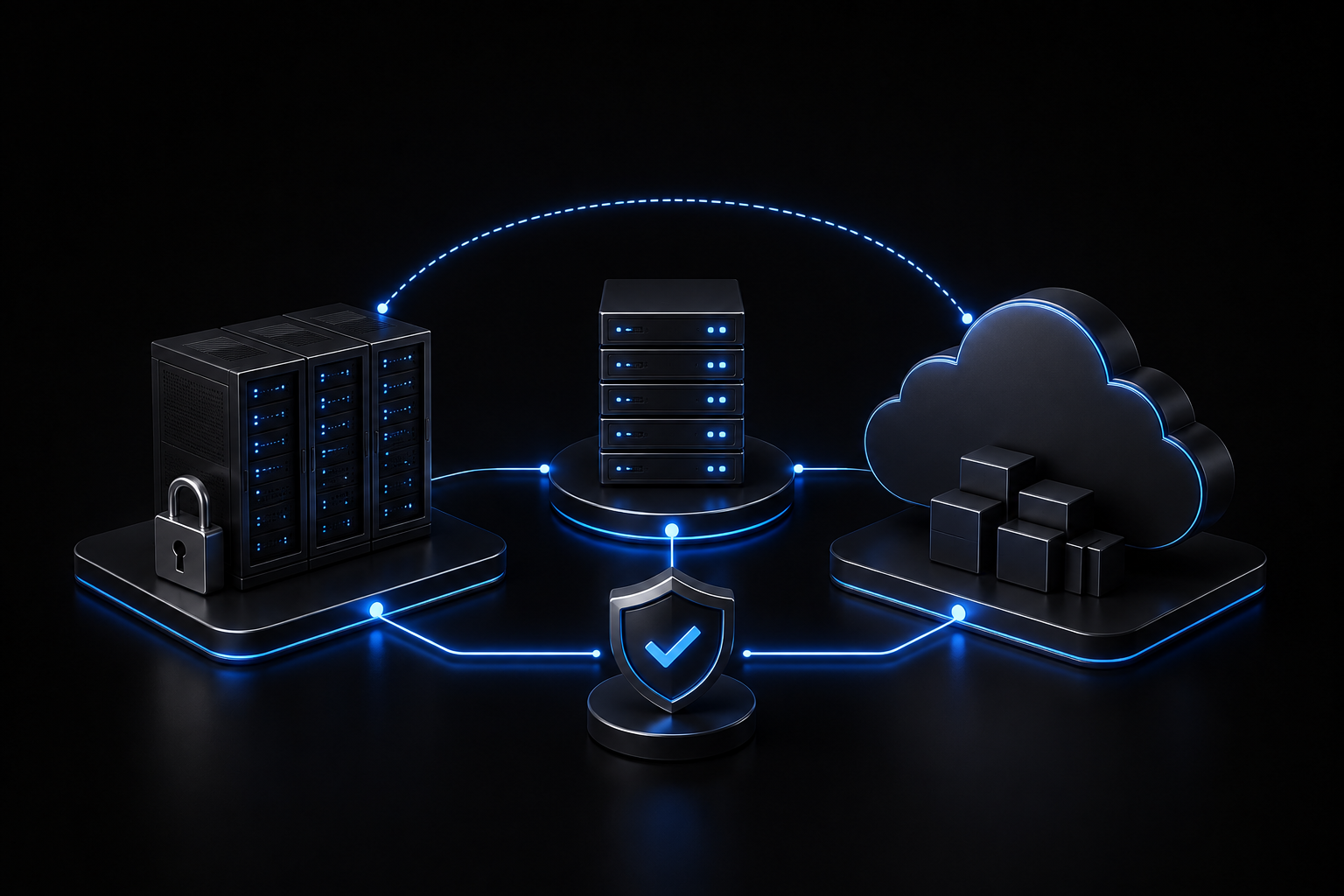
Not every organization can or wants to move entirely to the public cloud. Regulatory requirements, legacy system dependencies, latency-sensitive applications, and existing infrastructure investments all create legitimate reasons for organizations to maintain a mix of on-premises and cloud infrastructure. Hybrid cloud architecture has emerged as a mainstream approach that allows organizations to capture cloud benefits where they make sense while retaining on-premises control where it’s needed. This article examines what hybrid cloud infrastructure involves and how organizations approach implementation.
What Is Hybrid Cloud Infrastructure?
Hybrid cloud refers to an IT architecture that combines on-premises infrastructure (or private cloud) with public cloud services, with workloads and data able to move between environments as needed based on business requirements, cost considerations, or regulatory constraints. This differs from a purely public cloud approach, where all infrastructure runs on a public cloud provider, and from a purely on-premises approach, where an organization maintains all infrastructure within its own data centers.
Effective hybrid cloud architecture typically involves more than simply operating separate on-premises and cloud environments independently; it requires integration between the two environments, including consistent networking, security policies, and often the ability to move workloads and data between environments with relative ease.
Why Organizations Choose Hybrid Cloud
Regulatory and Data Sovereignty Requirements
Certain industries and jurisdictions impose strict requirements on where specific types of data can be stored and processed. Hybrid cloud allows organizations to keep regulated data on-premises or in a private cloud environment that meets specific compliance requirements, while still leveraging public cloud services for less sensitive workloads.
Legacy System Dependencies
Many enterprises maintain critical legacy applications that were never designed for cloud environments and would require substantial re-architecture to migrate successfully. Hybrid cloud allows these systems to remain on-premises while newer applications and workloads take advantage of public cloud capabilities.
Latency-Sensitive Workloads
Certain applications, particularly those involving real-time processing of data generated by on-premises equipment or requiring extremely low latency, may perform better when processing occurs close to the data source rather than requiring round-trip communication with a distant public cloud data center.
Existing Infrastructure Investment
Organizations with significant recent investment in on-premises infrastructure may reasonably choose to extend the useful life of that investment through a hybrid approach, gradually shifting workloads to the cloud as existing hardware reaches end-of-life rather than abandoning that investment prematurely.
Cost Optimization for Predictable Workloads
For workloads with highly predictable, steady-state resource requirements, on-premises infrastructure can sometimes be more cost-effective over the long term compared to public cloud pricing, while variable or unpredictable workloads benefit more from the cloud’s elastic scaling. Hybrid architectures allow organizations to place each workload in the most cost-effective environment.
Disaster Recovery and Business Continuity
Hybrid architectures often support disaster recovery strategies where the public cloud serves as a backup environment for on-premises systems, or vice versa, providing geographic and infrastructure diversity without requiring a complete duplicate on-premises data center.
Core Components of Hybrid Cloud Infrastructure
Network Connectivity
Reliable, secure, and sufficiently high-bandwidth connectivity between on-premises and cloud environments is foundational to hybrid cloud architecture. This typically involves dedicated connections, such as AWS Direct Connect, Azure ExpressRoute, or Google Cloud Interconnect, which provide more consistent performance and security compared to connections routed over the public internet.
Unified Identity and Access Management
Consistent identity management across on-premises and cloud environments, often achieved through directory synchronization or federated identity solutions, ensures that access control policies remain coherent regardless of where a given resource or application resides.
Consistent Security Policies
Hybrid cloud security requires extending consistent security monitoring, threat detection, and policy enforcement across both environments, since attackers will target whichever environment presents the weaker security posture, making inconsistent protection a significant vulnerability.
Workload Orchestration and Management
Container orchestration platforms, particularly Kubernetes, have become a common abstraction layer for managing workloads consistently across on-premises and cloud environments, allowing applications to be deployed and managed using consistent tooling regardless of the underlying infrastructure location.
Data Management and Synchronization
Organizations need clear strategies for managing data consistency and synchronization between on-premises and cloud environments, particularly for applications that need to access or update the same data regardless of where a specific request originates.
Unified Monitoring and Management Tools
Centralized monitoring and management tooling that provides visibility across both on-premises and cloud environments significantly simplifies operations compared to maintaining entirely separate monitoring and management processes for each environment.
Hybrid Cloud Deployment Models
Cloud Bursting
In this model, applications primarily run on-premises but can automatically scale into the public cloud during periods of peak demand that exceed on-premises capacity, providing cost-effective baseline capacity combined with elastic scalability for demand spikes.
Distributed Applications
Some hybrid architectures distribute different components of a single application across on-premises and cloud environments based on the specific requirements of each component, such as keeping a sensitive database on-premises while running the application’s web-facing components in the public cloud.
Disaster Recovery Hybrid Model
In this common pattern, primary production workloads run on-premises, with the public cloud serving as a disaster recovery environment that can be activated in the event of an on-premises outage, providing cost-effective business continuity without requiring a fully duplicated on-premises secondary data center.
Private Cloud Plus Public Cloud
Some organizations implement a private cloud environment (essentially cloud-like infrastructure and management tools deployed within their own data center) alongside public cloud usage, aiming to capture some of the operational benefits of cloud computing (self-service provisioning, standardized infrastructure) while retaining the physical control of on-premises infrastructure.
Key Technologies Enabling Hybrid Cloud
Software-Defined Networking
Software-defined networking technologies allow for more flexible and consistent network configuration across hybrid environments, simplifying the extension of network policies between on-premises and cloud infrastructure.
Hyperconverged Infrastructure
Hyperconverged infrastructure platforms, which combine compute, storage, and networking into a unified, software-defined system, are often used as the on-premises foundation for hybrid cloud architectures, since they typically offer better integration with cloud management tools compared to traditional, more siloed infrastructure approaches.
Hybrid Cloud Management Platforms
Purpose-built hybrid cloud management platforms provide unified provisioning, monitoring, and governance capabilities that span both on-premises and public cloud environments, reducing the operational complexity of managing what would otherwise be entirely separate infrastructure environments.
Container Platforms
As mentioned, container orchestration platforms have become particularly important for hybrid cloud, since containerized applications can generally be deployed consistently across on-premises and cloud infrastructure with minimal modification, significantly simplifying workload portability compared to traditional virtual machine-based deployments.
Common Implementation Challenges
Network Complexity and Latency
Designing network architecture that provides adequate performance, security, and reliability between distributed environments requires careful planning, and inadequate network design can result in significant application performance issues, particularly for workloads with frequent cross-environment communication.
Consistent Security Posture
Maintaining truly consistent security controls across fundamentally different infrastructure environments (on-premises hardware and virtualization versus cloud-native services) requires deliberate effort, since the native security tools and configuration models differ significantly between environments.
Skill Requirements
Hybrid cloud requires IT teams to maintain expertise across both traditional on-premises infrastructure management and cloud-native technologies, representing a broader skill requirement than a purely cloud-native or purely on-premises approach.
Cost Visibility and Management
Comparing and managing costs across on-premises infrastructure (with its capital expenditure model) and public cloud (with its operational expenditure model) requires different financial frameworks, and organizations sometimes struggle to develop a unified view of total infrastructure costs across both environments.
Data Gravity and Migration Complexity
Large volumes of data can be expensive and time-consuming to move between environments, creating “data gravity” that can constrain architectural decisions about where specific workloads should run, since applications often perform best when located close to the data they need to access.
Best Practices for Hybrid Cloud Success
Organizations pursuing hybrid cloud architecture generally benefit from starting with a clear assessment of which workloads genuinely benefit from cloud migration versus which are better suited to remain on-premises, rather than pursuing hybrid cloud as an end in itself. Establishing consistent security and identity management across both environments from the outset, rather than retrofitting consistency later, significantly reduces long-term complexity and risk. Investing in adequate network connectivity between environments, sized appropriately for actual data transfer and latency requirements, prevents performance issues that can undermine the viability of the hybrid approach. Finally, adopting container orchestration and infrastructure-as-code practices where feasible can significantly simplify the operational complexity of managing workloads consistently across hybrid environments.
Industry Applications of Hybrid Cloud
Different industries have developed distinct patterns for applying hybrid cloud architecture based on their specific operational and regulatory contexts. Financial services organizations frequently maintain core banking systems and sensitive customer financial data on-premises or in private cloud environments subject to strict regulatory oversight, while leveraging public cloud for customer-facing digital banking applications, data analytics, and less sensitive workloads. Healthcare organizations often keep electronic health record systems and other systems handling protected health information within tightly controlled on-premises or private cloud environments, while using public cloud for research computing, administrative applications, and patient engagement tools that don’t directly handle the most sensitive clinical data. Manufacturing organizations commonly use hybrid architectures to process time-sensitive operational technology data generated by factory floor equipment locally, close to the source, while sending aggregated data to the public cloud for broader analytics, reporting, and cross-facility comparison.
These industry patterns illustrate that hybrid cloud adoption is rarely an all-or-nothing decision, but rather a deliberate architectural approach that places each specific workload in the environment best suited to its particular requirements.
Edge Computing and Hybrid Cloud Convergence
As edge computing has matured, the line between hybrid cloud and edge architecture has increasingly blurred. Organizations processing data generated by distributed IoT devices, retail locations, or industrial equipment increasingly deploy compute capacity at or near the edge, sometimes using cloud providers’ own edge computing offerings, which extend their management and deployment tools to smaller, distributed edge locations rather than requiring organizations to build and manage this distributed infrastructure entirely independently.
This convergence has meaningfully simplified certain aspects of hybrid architecture, since organizations can increasingly manage on-premises, edge, and public cloud resources through more unified tooling than was available when hybrid cloud first emerged as a distinct architectural pattern, though genuine technical and operational complexity around distributed infrastructure management still remains significant.
Evaluating When Hybrid Cloud Is the Wrong Choice
While hybrid cloud offers genuine benefits for many organizations, it isn’t universally the optimal architecture. Organizations without specific regulatory, latency, or legacy system constraints that would justify maintaining on-premises infrastructure sometimes find that a fully cloud-native approach offers lower total complexity and cost than a hybrid architecture, since hybrid environments inherently require maintaining expertise, tooling, and operational processes across two fundamentally different infrastructure paradigms rather than consolidating around a single, more standardized approach.
Organizations considering hybrid cloud should honestly assess whether their specific reasons for maintaining on-premises infrastructure represent genuine, durable requirements, or whether they reflect more circumstantial factors, such as existing infrastructure investment or organizational inertia, that might reasonably be resolved through a more complete cloud migration over a longer time horizon rather than committing to hybrid architecture as a permanent operating model.
Skills Development for Hybrid Cloud Teams
Given the broad skill set hybrid cloud environments demand, organizations should invest deliberately in developing team capabilities spanning both traditional infrastructure management and cloud-native technologies, rather than assuming existing on-premises infrastructure staff will naturally develop cloud expertise without dedicated training investment, or that newly hired cloud specialists will easily adapt to the specific constraints and legacy considerations of the organization’s existing on-premises environment. Cross-training programs that pair experienced infrastructure staff with cloud specialists, structured certification paths, and dedicated time allocated for hands-on learning with new hybrid cloud tooling all help organizations build the genuinely blended expertise that successful hybrid cloud operations require over the long term.
Conclusion
Hybrid cloud infrastructure offers a pragmatic middle path for organizations that need the flexibility and scalability of public cloud services while maintaining specific workloads, data, or applications on-premises due to regulatory, technical, or business requirements. While hybrid architectures introduce additional complexity compared to a purely single-environment approach, organizations that invest in consistent networking, security, and management practices across both environments can successfully capture the benefits of each while managing the associated risks and operational overhead.